SciTechDaily Newsletter

"A diamond smaller than a grain of sand could transform heart monitoring."

Views expressed in this science, space, and technology update are those of the reporters and correspondents.  Accessed on 27 September 2026, 1405 UTC.

Content and Source:  "SciTechDaily Newsletter."

https://mail.google.com/mail/u/0/#inbox/FMfcgzQhWfQxPspJNvCzjDXmNHJNmNGc

Please check email link or scroll down to read your selections.  Thanks for joining us today.

Russ Roberts (https://hawaiisciencemonitor.blogspot.com).

SciTechDaily Newsletter
The latest science, space, and technology news.
 
A Diamond Smaller Than a Grain of Rice Could Transform Heart Monitoring
 
2026-09-27 11:58:47 +00:00
Human Anatomy Heart Structure 3DA new generation of quantum sensors could improve medical diagnostics. Diamond-based quantum sensors could make it easier to record the heart’s activity without attaching electrodes to the skin. Physicists at Johannes Gutenberg University Mainz (JGU) have used a tiny diamond to measure the heart’s magnetic field, building their sensor into a fiber-based instrument designed as [...]
Read more...


Tiny Diamond Beams Could Unlock More Powerful Quantum Networks
 
2026-09-27 11:23:30 +00:00
Conceptual Illustration of Integrated Quantum Photonic CircuitBuilding a circuit around a tiny diamond beam offers a way to keep more of the light that future quantum computers and networks could use. Building a quantum network often comes down to a stubborn materials problem. Diamond can host quantum emitters, tiny systems that produce light signals, while other materials are better suited to [...]
Read more...


The Disconnection of the Large Hadron Collider Has Begun
 
2026-09-27 10:48:31 +00:00
CERN Director General Mark Thomson LHC DisconnectionCERN has begun disconnecting parts of the Large Hadron Collider so it can replace aging beam focusing magnets with a much more powerful generation. The new magnets will be about 40% stronger, helping create more particle collisions and ushering the LHC into its High Luminosity era. The Large Hadron Collider (LHC) stretches 27 km around [...]
Read more...


Scientists Discover a New Potential Treatment Target for High Blood Pressure
 
2026-09-27 02:58:54 +00:00
Measurement of Blood Pressure Heart CardiologyThe discovery could lead to more targeted treatments that reduce inflammation linked to high blood pressure. For nearly half of U.S. adults who have high blood pressure, controlling the condition can be a persistent challenge. Researchers at the University of Missouri are investigating whether a protein called TG2, found in blood vessels and certain immune [...]
Read more...


Researchers Find a Surprising Link Between Bone Density and Brain Aging
 
2026-09-27 02:23:47 +00:00
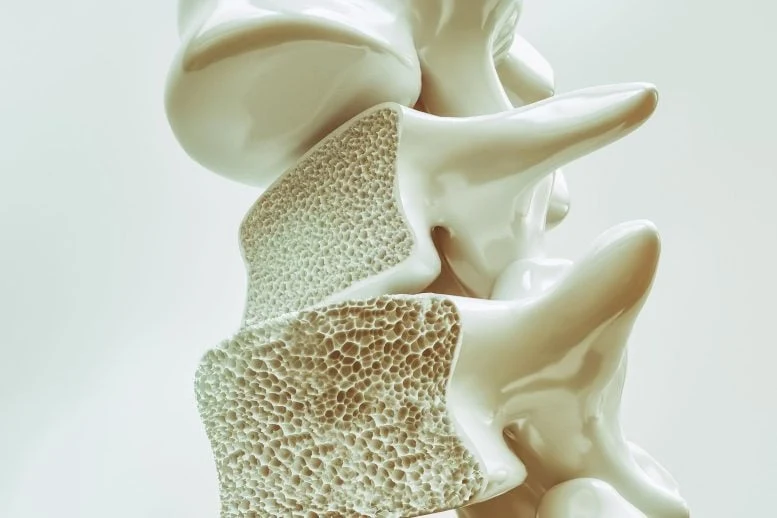
Osteoporosis in SpineRoutine chest CT scans may contain clues about more than bone health. A scan taken to examine the chest may also reveal clues about how the brain is aging. Researchers at Johns Hopkins University found that people with lower bone mineral density in the spine tended to experience faster cognitive decline and more rapid changes [...]
Read more...


Researchers Find Creatine’s Benefits Extend Far Beyond the Gym
 
2026-09-27 01:48:02 +00:00
Man Scooping Sport Supplement Creatine PowderNew research suggests creatine may help adults ages 45 to 65 gain lean tissue and strength, even without a structured exercise program. Creatine, a naturally occurring compound that helps replenish cellular energy, is widely used to build muscle and improve athletic performance. Its effects may also be useful in middle age, when maintaining muscle becomes [...]
Read more...


A 9-Million-Year-Old Tooth Just Challenged What Scientists Thought They Knew About the Atacama Desert
 
2026-09-26 23:17:04 +00:00
Paleoenvironmental Reconstruction of Cardiatherium CroppedScientists were surprised to discover a fossilized tooth from a capybara that lived almost 9 million years ago in what is now northern Chile’s Atacama Desert. Chile’s Atacama Desert is an unlikely place to find traces of capybaras, the world’s largest living rodents, whose lives revolve around water and wetland plants. Yet a fossilized tooth [...]
Read more...


Scientists Discover a “Fire Amoeba” That Defies Life’s Heat Limit
 
2026-09-26 22:42:16 +00:00
Sulfur Pool Lassen National ParkA newly identified amoeba from a volcanic region of California is challenging long-held assumptions about how much heat complex cells can withstand. Heat can quickly become destructive to complex cells. As temperatures rise, proteins can lose their shape, DNA can sustain damage, and essential cellular processes can begin to fail. This has made extreme heat [...]
Read more...


Fossilized Vomit Reveals a Surprising Secret About Plesiosaur Behavior
 
2026-09-26 22:07:52 +00:00
Artist’s Impression of Plesiosaurs Feeding on the Sea FloorUnusual fossils from an ancient North Sea delta may reveal where plesiosaurs fed. Fossilized vomit is not the kind of evidence paleontologists usually dream about finding. But it may have revealed an unexpected part of plesiosaur behavior. More than 20 fossilized masses recovered from rocks beneath the North Sea contain shells and other hard remains [...]
Read more...


Autism Study Reveals Two Opposing Molecular Patterns in the Brain
 
2026-09-26 16:52:34 +00:00
Head Brain Diseases Puzzle Pieces Autism Mental HealthAn analysis of more than 1,000 gene activity profiles from mouse brains reveals shared molecular patterns that vary by sex and respond differently to experimental drugs. Autism spectrum disorder (ASD), a condition involving differences in brain development, has been linked to more than 1,200 risk genes. Studying mutations individually has revealed many effects on the [...]
Read more...


Scientists Reveal What Workout Recovery Techniques Actually Work
 
2026-09-26 16:17:12 +00:00
Fatigue Fitness Woman Outdoor Cardio ExerciseIce baths, massage, compression gear, and supplements promise faster recovery, but the science shows that feeling less sore does not always mean your muscles have actually recovered. An ice bath may help sore muscles feel better after a hard workout, but using one too often could come with a trade-off. Less soreness now may also [...]
Read more...


Scientists Put Anti-Aging Treatments to the Test – These Ones Actually Changed Biological Age
 
2026-09-26 15:42:56 +00:00
Biological Aging Doctor ClockThe search for effective anti-aging treatments has produced clear front-runners: healthy lifestyle changes and certain prescription drugs. Raghav Sehgal originally came to Yale hoping to apply computer science to cancer. With an engineering background and experience building a computational biology startup, he was well positioned to investigate the disease through data. His research direction changed [...]
Read more...


A Quantum Prediction From 1931 Has Finally Come to Life
 
2026-09-26 12:32:59 +00:00
Artistic Illustration of Ultracold Quantum Gas NeonPhysicists have observed “Bethe strings” in an ultracold gas nearly a century after Hans Bethe predicted them, providing a controlled setting for further study. In 1931, physicist Hans Bethe predicted that particles in certain quantum systems could bind together into groups called Bethe strings. These groups could exist only in one dimension, where particles move [...]
Read more...


Scientists Just Watched a Single Quantum of Sound Vanish for the First Time
 
2026-09-26 11:57:49 +00:00
Sound Quantum JumpStanford physicists observed a tiny vibrating structure lose a single unit of sound energy in a sudden quantum jump. The finding could help advance quantum computing and precision sensing. A tiny mechanical resonator, a structure that vibrates like a tuning fork, has given Stanford researchers a close look at how sound disappears at the quantum [...]
Read more...


New Satellite Engine Could Use Earth’s Atmosphere as Fuel To Stay in Orbit Indefinitely
 
2026-09-26 11:22:30 +00:00
Fully Assembled RF Helicon Based Plasma ThrusterA satellite engine that uses atmospheric gases as fuel shows promise in laboratory tests and modeling, but its performance on a mission remains unproven. Choosing an orbit for a satellite involves balancing benefits and drawbacks. Very Low Earth Orbit (VLEO), which spans roughly 100 to 450 km (62 to 280 miles) above Earth, offers several [...]
Read more...


1042 N. El Camino Real Ste B-395
ENCINITAS California 92024
US


Comments

Popular posts from this blog

Science | The Guardian

Latest from Live Science

Scientific American Content