Think of a galaxy and it likely looks like a lonely home at night, its stars glowing brightly against the black of space.
But new research suggests that there may be other galaxies around; they just don’t have the lights on because there’s no electricity. (I think we’ve stretched this analogy as far as it can go.)
Researchers have puzzled for years over why some galaxies have all the things needed to form stars but fail to do so. But scientists have found a promising candidate to study so-called dark galaxies, and doing so could help them test the best models of galaxy formation.
Astronomers used observations from two radio telescopes to chronicle an object known as AGC 322753. It contains roughly 2 billion times the sun's mass in hydrogen, yet appears to have no stars (though it’s likely there are at least some stars, but they’re very faint). If confirmed, it would be an unusually massive example of a starless galaxy.
So what’s going on here? Astronomers’ most successful model of the cosmos, known as Lambda-CDM, assumes the existence of two invisible ingredients: dark energy, the mysterious property thought to be driving the accelerating expansion of the universe, as well as cold dark matter, a hypothetical substance that physicists think makes up about 85 percent of the universe’s matter.
Clumps of dark matter, called haloes, provide the gravitational scaffolding for galaxies to form and grow, according to the model. Gas collects inside these haloes, eventually cooling and collapsing to form stars. But astronomers are still trying to understand why this process appears to happen in some haloes but not others. The research around AGC 322753 provides some tantalizing clues. But to really get a handle on what’s going on will require further observations, such as ones made by the Very Large Array, a network of radio antennas in New Mexico, to confirm whether AGC 322573 is truly a dark—or almost dark—galaxy.
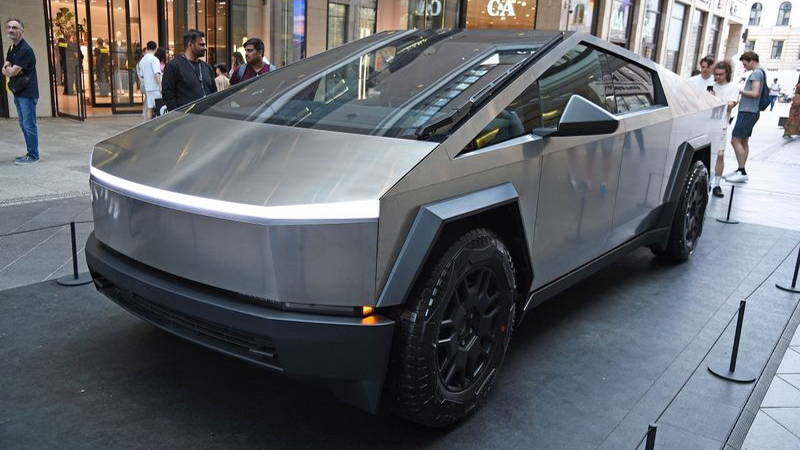
Also on my radar: the Cybertruck’s untimely demise. Tesla will end production of its much-derided polygon on wheels at the company’s Gigafactory Texas next year. There are two important outcomes here. One is that guys who like to be spit on and sworn at will have to find a new way to get their kicks. The other, arguably more important, one is that it speaks to the growing momentum for smaller, more affordable EVs.
The Cybertruck uses a massive 123-kilowatt-hour battery that clocks in at around 1,600 pounds, or around a quarter of the vehicle's weight. Its cancellation, along with Ford’s F-150 Lightning late last year, are a sign that big EVs with big price tags aren’t really it for Americans. At the same time, a growing wave of smaller, cheaper models, from Slate’s bare-bones pickups and SUVs to Ford’s forthcoming sub-$30,000 pickup, indicate where the market might be headed. That’s great for easing pressure on the battery supply chain, pedestrian safety, and affordability.







Comments
Post a Comment